• Investment Idea: Generac is Strategically Shifting Focus to Capitalize on the Data Center Construction Boom, a Pivot that Could Drive 100% Upside Potential within the Next Two Years.

    Generac’s Strategy is Pivoting: The company is aggressively shifting its focus from its dominant, but volatile, residential generator market (53.9% of sales) toward the high-growth Commercial & Industrial (C&I) sector. This pivot is driven by the soaring global demand for backup power required by AI infrastructure and new data centers.

    Valuation Suggests Upside: The stock currently trades at a premium valuation, indicating the market is pricing in the success of the data center pivot. A normalized valuation model suggests an implied 2028 share price of approximately $371.30, presenting a potential buying opportunity if the company successfully executes its industrial strategy.

    High-Growth Market Opportunity: Generac is positioning itself to capture significant share in the data center backup power market, which is estimated to be worth up to $15 billion annually for diesel generators. The company holds a competitive advantage over rivals like Cummins and Caterpillar due to a significantly shorter generator lead time (30–36 weeks versus 50–70+ weeks) and specialized Modular Power Systems technology.

    2025 Financial Performance and 2026 Guidance: Total net sales contracted 2.0% in 2025 primarily due to a 7% decline in residential sales, which suffered from a mild power outage environment. For 2026, management forecasts a mid-teens percentage increase in net sales (targeting $4.84 billion), anticipating a 30% expansion in the C&I segment, fuelled by a $400 million data center backlog.

    (more…)
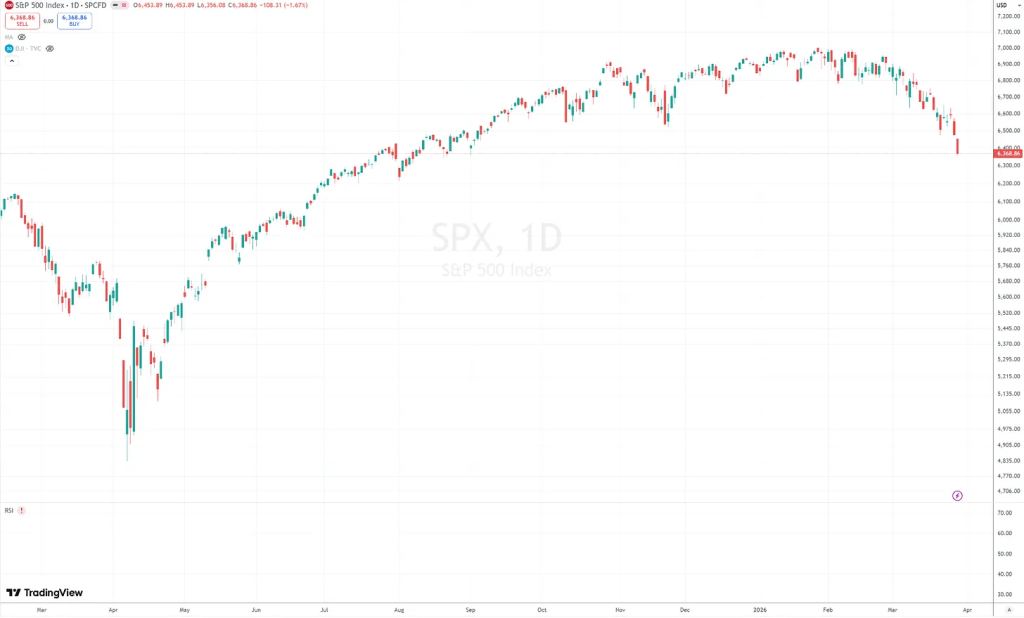
  • Euqities Suffer Broad Sell-Off, Bond Yields Spike Driven by Surging Crude Prices, and Rising Systemic Credit Stress

    United States

    Equities Enter Correction Territory U.S. equities suffered sell-offs over the week, culminating in a fifth consecutive losing week for Wall Street. The S&P 500 declined 1.7% by Friday’s close, marking its most dismal weekly performance since the onset of the current Middle East conflict. Concurrently, the Dow Jones Industrial Average shed 793 points, representing a 1.7% drop that officially pushed the index into correction territory—defined as a 10% decline from its recent peak. This follows the trajectory of the Nasdaq Composite, which fell a further 2.1% to 20,948.36, having already breached the 10% correction threshold earlier in the week.

    nergy Markets Surge Amid Geopolitical Strain Commodity markets experienced violent upside volatility as Brent crude eclipsed the $110 per barrel threshold. This represents a premium over the roughly $70 baseline observed prior to the conflict. The market increasingly pricing prolonged disruptions in the Strait of Hormuz.

    (more…)
    • Semiconductor supply chain is booming: The supply deficit leads to elevated prices and gross margins across the entire AI semiconductor supply chain. We identify the stocks that benefit from supply/demand imbalance in 2026-2027.
    • AI chip complexity increases: NVIDIA’s transition to the Rubin platform, with 60% more transistors and 50% larger HBM4 capacity triggers fierce competition for TSMC’s 3nm capacity and HBM4 memory supply.
    • TSMC’s Absolute Capacity is exhausted: The simultaneous migration of NVIDIA, AMD, and custom hyperscaler ASICs to the 3nm standard has completely absorbed TSMC’s fabrication and CoWoS packaging capacity through 2026, driving prices and margins up.
    • Bottlenecks in Memory and down the supply chain: The HBM market is in a deep deficit, allowing the leading 3 producers to dictate premium pricing and drive gross margins to record levels. The physical complexity of new architecture has severely extended diagnostic times, creating testing and rack assembly bottleneck.
    (more…)
  • Recently several large asset managers – BlackRock, Blackstone and Blue Owl faced stress with their private credit funds. We try to understand what is happening in the industry, what became the trigger, try to assess the impact the situation could have on the asset managers and broader private credit market. We dive deep into risk metrics analysis and make conclusions if recent pullbacks in share prices of listed BDC’s made the valuation attractive to enter the sector. We look at why failure to convince OBDC II investors to merge with OBDC and continuous discount to NAV of OBDC is structurally important for Blue Owl equity story. We discuss the current structural weaknesses of public BDC’s and what needs to happen for the sector to become attractive once more for equity investors.

    (more…)
  • With the closure of Strait of Hormuz one of the biggest global LNG suppliers  – Qatar is blocked from delivering LNG cargoes. The blockade already significantly impacted prices for spot cargo deliveries in Europe and Asia. If the supplies won’t be re-established in the next several weeks, the elevated gas prices risk to affect economies of Europe, Asia and have significant effect on earnings of certain sectors. Below we try to understand the impact of the Qatari LNG cargoes blockade, look at the LNG market structure, at volumes and prices, seasonality in prices and supplies, analyse transmission mechanism from elevated European gas prices to electricity pricing and discuss winners and losers of the current supply disruption and why the situation may not be as precarious as it seems.

    (more…)
  • On February 28, 2026, the United States and Israel launched a military operation against Iran, targeting key leadership, nuclear sites, and military infrastructure. Below we assess the effects of the conflict on the oil price and supply/demand, discuss why it is critical for the oil market and global economy, look at possible resolution avenues and available mitigation instruments. We look at the historical parallels and companies that outperformed during the previous oil price shocks.  

    Strait of Hormuz closure, effects on oil supply/demand balance and alternative supplies. – The key risk for the global economy is the effective closure of the Strait of Hormuz and resulting economic consequences. The direct impact is the risk of continuity of oil and LNG supply to global markets. The Strait of Hormuz facilitates the daily transit of approximately 20 million barrels of crude oil and petroleum products, representing between 15% and 20% of total global consumption. The waterway processes 20% of the LNG trade, equating to approximately 81 million tonnes annually, predominantly sourced from Qatar. The secondary effect, but ultimately more important, is the impact of higher oil prices on inflation, inflation expectations and as a result on interest rates.

    (more…)
  • Summary

    The U.S. Supreme Court’s 6-3 decision striking down the use of the International Emergency Economic Powers Act (IEEPA) for sweeping global tariffs marks a turning point for international trade. By ruling that the US executive branch overstepped its constitutional authority to impose taxes, the Court immediately invalidated the complex web of “reciprocal” tariffs and bilateral carve-outs negotiated over the past year. The administration reacted by invoking Section 122 of the Trade Act of 1974, replacing the targeted levies with a temporary, flat 15% global tariff. While overall headline tariff burden decreased somewhat, the underlying friction of protectionism remains firmly intact though through a different legal mechanism.

    (more…)
  • The contents in here should not be construed as or relied upon in any manner as investment, legal, tax, or other advice. You should consult your own advisers as to legal, business, tax, and other related matters concerning any investment. The value of stocks, shares and any dividend income may fall as well as rise and is not guaranteed, so you may get back less than you invested. You should not invest any money you cannot afford to lose, and you should not rely on any dividend income to meet your living expenses. Any projections, estimates, forecasts, targets, prospects and/or opinions expressed in these materials are subject to change without notice. Any charts provided here are for informational purposes only, and should not be relied upon when making any investment decision. Certain information contained in here has been obtained from third-party sources, and has not been independently verified.

    Designed with WordPress